
For years, LASIK has been one of the best-known options for SoCal Eye patients who wanted freedom from glasses or contact lenses. But as patients get older, their vision correction needs change. Presbyopia—the age-related loss of the eye’s ability to focus on nearby objects—can make traditional laser vision correction less attractive for some patients.
That is one reason EVO ICL is gaining momentum.
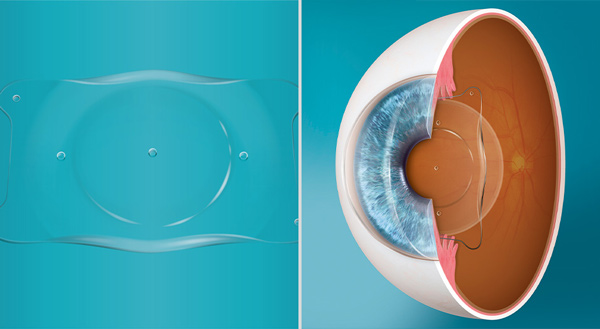
EVO ICL, or Implantable Collamer® Lens, offers a different approach to vision correction. Instead of reshaping the cornea with a laser, EVO ICL places a small lens inside the eye to correct nearsightedness, with a toric version available for patients who also have astigmatism.
And the potential patient population has recently expanded significantly. In November 2025, the FDA approved an expansion of the EVO ICL indication from patients ages 21–45 to patients ages 21–60. That change has opened the door to more adults who may not be ideal candidates for traditional laser vision correction.
What Is EVO ICL?
EVO ICL is a small, flexible lens made from a proprietary biocompatible material called Collamer. During the procedure, the surgeon inserts the lens through a small opening and positions it behind the iris and in front of the eye’s natural lens.
Unlike cataract surgery, the natural lens is not removed.
The EVO ICL works by bending incoming light so that it focuses properly on the retina, improving distance vision. Because the cornea is not reshaped and the natural crystalline lens remains in place, EVO ICL takes a fundamentally different approach from LASIK.
The procedure is typically quick and minimally invasive, and the lens can be removed if circumstances change in the future.
Why Are Older Patients Showing Interest?
One of the biggest reasons is simply that patients’ vision needs evolve with age.
A 45-, 50-, or 55-year-old may still be significantly nearsighted but may also be experiencing presbyopia. LASIK can correct the distance prescription, but it does not stop the natural aging process that affects near vision.
That can make the conversation around vision correction more complicated.
For appropriately selected patients, EVO ICL provides another option to consider. Importantly, being older does not automatically make someone a candidate—or exclude someone—from a particular procedure. A comprehensive eye examination is necessary to evaluate the health and anatomy of the eye, the stability of the prescription and other factors.
The FDA’s expanded indication to age 60 makes this conversation particularly relevant for today’s patients.
Why Is EVO ICL Gaining Momentum?
The growth of EVO ICL is not just anecdotal.
STAAR Surgical’s U.S. EVO ICL sales have grown at a double-digit pace, signaling accelerating adoption of this alternative to LASIK.
These numbers reflect a broader change in the refractive surgery conversation: patients and surgeons are increasingly considering lens-based correction alongside traditional laser procedures.
Who Might Consider EVO ICL?
EVO ICL may be considered for appropriately screened adults with moderate to high nearsightedness, including some patients with astigmatism.
It can be particularly interesting for patients who:
Have moderate or high myopia
Have concerns about corneal tissue removal
May not be an ideal candidate for LASIK because of corneal characteristics
Experience dry-eye concerns
Are within the FDA-approved age range
Want to explore a lens-based alternative to laser vision correction
However, EVO ICL is not right for everyone. Eye health, anterior chamber depth, endothelial cell density, prescription stability and other factors must be evaluated before surgery.
A Growing Choice in Vision Correction
The rise of EVO ICL doesn’t necessarily mean that LASIK is going away. Instead, it gives patients and eye surgeons another tool.
For younger patients, LASIK may remain an excellent option when appropriate. For others—particularly patients with higher prescriptions, certain corneal considerations or changing vision needs associated with age—EVO ICL may offer an alternative worth discussing.
As the technology continues to expand and more surgeons gain experience with the procedure, EVO ICL is becoming an increasingly visible part of the modern refractive surgery landscape.
EVO ICL, Long Beach.
All treatment begins with a Consultation with a SoCal Eye Refractive Surgeon in Long Beach. At this consultation, the Ophthalmologist will perform a complete eye exam with dilation and discuss options that are right for you. SoCal Eye feels strongly that patients should be informed and educated on all aspects of the procedure to ensure the best experience. For EVO Visian ICL treatment in Long Beach, Schedule an Appointment today at (562) 531-2020 or send us an Online Consultation Request

